
A New Ball Raises Old Questions (Part 2) 🍒🪩🗽
When I learned that a NEW Ball was created for Times Square’s 2025 → 2026 New Year’s Eve Celebration, I realized I didn’t actually know the story of the Ball Drop—when the tradition began, how many iterations of the Ball came before it, and the roots of this globally celebrated ritual of connection. I find it interesting to know where our symbols and rituals of connection come from and fun to share that history with you—and your boo, if you have one—so that this year’s rituals, and the ones that come after, are more meaningful.
I’ll start by describing this year’s Constellation Ball, next I’ll discuss Time Balls and the Ball Drop’s mariner roots, then I’ll touch on the inspiration for the creation of our global set point of time, followed by a timeline of the nine iterations of New York’s NYE Ball Drop. Finally, I’ll end with a brief highlight of my time there, what’s in store for us at CouplesTherapy.co in the year ahead, and an invitation for a second chance to see the Ball Drop this year!
It’s a PIECE, for sure—but I hope you’ll find it interesting, make it down this blog drop smarter, and that New Year’s Eve might mean more to you when you reach the end than it ever has before.
So get a cup of cocoa, make yourself comfy, and let’s dive in!
The Constellation Ball
This past NEW Year’s Eve, something NEW happened in NEW York City!
A NEW Ball dropped at One Times Square for their NYE celebration—The Constellation Ball! One that stands 12.5 feet in diameter, weighs 12,350 pounds, and has a metal geodesic frame of aluminum for strength, durability, and weather resistance.
The interior is equipped with interactive LED light pucks that illuminate and animate in sync with sound. The LED lights are mounted behind and within the frame and shine through its surface. The surface of the Constellation Ball is uniquely adorned with 5,280 solid circular Waterford Crystal panels, different from the triangular-shaped Waterford Crystal panels used on the 1999 Millennium Ball.
For this iteration of the Ball, there are three different crystal sizes, each featuring a design that celebrates THE BALL’S SPIRIT OF ETERNAL POSITIVITY. The 2025 INFINITE EDITION crystals include: Infinite Joy (4” in diameter — 1,420 crystals), Infinite Light (3” in diameter — 2,840 crystals), and Infinite Beginnings (1.5” in diameter — 1,020 crystals). A new theme will be introduced later this year for the Ball’s 2026 crystals, with three fresh designs.
The function of the crystal is optical and symbolic. They refract and diffuse light and create sparkle, depth, and pattern, with the LED lights dancing in sync to sound—an experience symbolic of celestial reverence and the interconnectedness of all of us.
Emotion is energy in motion and the Constellation Ball is one big lit-up Ball FULL of it!
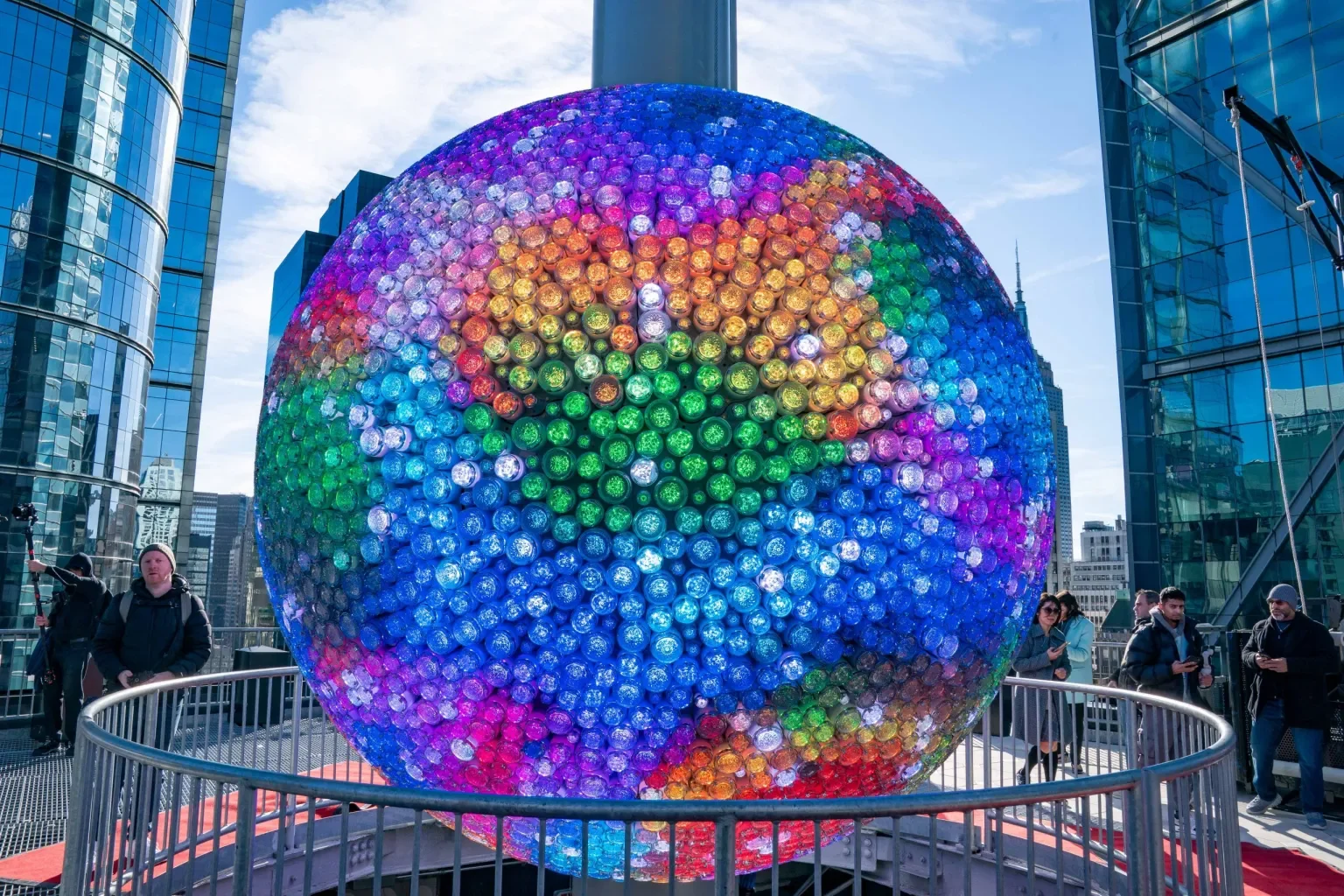
The NEW 2025 Constellation Ball 🪩🗽❤️
Time Balls and Mariner Roots: Sound → Sight
Upon my research, I learned New York’s New Year’s Eve Ball Drop has a rich history and origins that predate the Ball Drop in Times Square. I’ll do my best to briefly summarize—but you know me, I like to be accurate, informative, and thorough, so hang in there and let’s learn something!
We’ll start with a basic premise…
People gather together to observe a Ball moving through space that marks the passing of time as it reaches a noteworthy destination.
Check √
Before Balls were dropped in celebration of the transition of years, there were Time Balls.
And before that—bells, cannons, and gunshots.
Time Balls were used as navigation instruments for mariners. They were designed to give ships a precise, visual signal of exact time. Each day, the Ball was raised on a pole and then dropped at a set moment (1:00 pm), allowing mariners on the River Thames to synchronize their marine chronometers (time measurers).
Time Balls replaced earlier sound-based signals such as bells, cannons, and gunshots because sound was imprecise and easily distorted by distance and weather, while an instantaneous visual drop provided the level of accuracy required for marine chronometers, navigation, coordination, and survival in an increasingly global maritime world.
Accurate chronometers were critical for calculating longitude. And correct longitude meant safe navigation, reduced risk of shipwreck, and reliable global travel and trade. If mariners set their chronometers incorrectly—even by just one second—the ship’s calculated longitude would be off by 15 arc-seconds, translating to about 460 meters (roughly a quarter of a nautical mile) at the equator—an error that could compound over time and become dangerous near coasts, shoals, or narrow ports.
The Royal Observatory
Historians estimate there were 150–200 time balls worldwide. The world’s first Time Ball was tested in 1829 in Portsmouth, England, by the British Admiralty, influenced by an officer named Robert Wauchope, who wanted a visual signal from the shore for sailors to set their chronometers by—as opposed to the then-practice of keeping time by gunshot sounds.
The first recorded Time Ball installed was at the Royal Observatory in Greenwich in 1833, located at Greenwich Park on a hilltop at Blackheath Avenue, London SE10 8XJ, United Kingdom—founded by King Charles II in 1675 to advance astronomy and solve the problem of longitude, making sea travel safer.
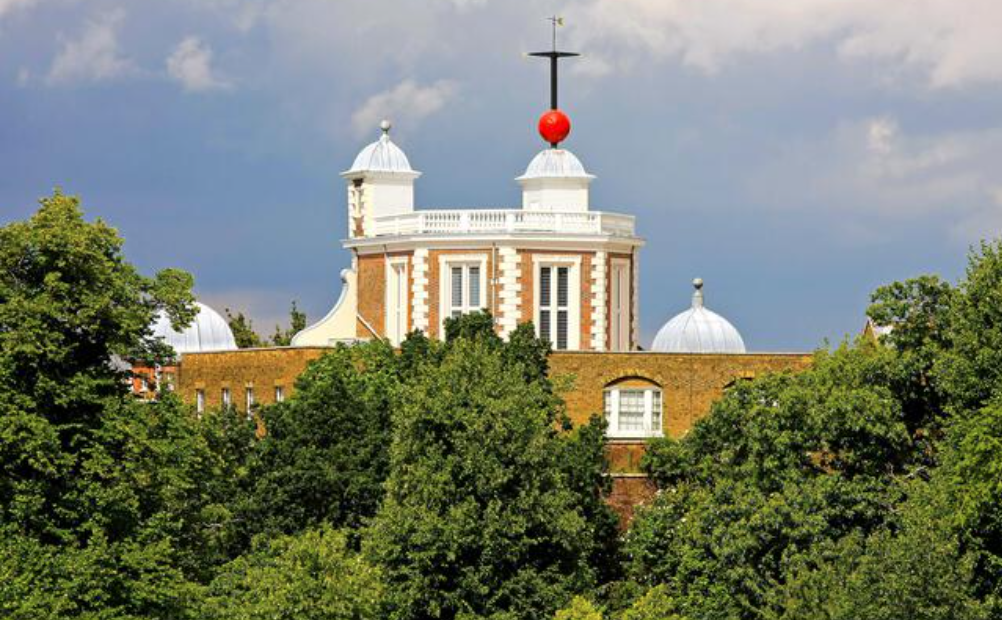
Fun fact: the Time Ball atop a hill in Greenwich Park is RED and I couldn’t help but notice it looks like our little cherry atop Love Is Fun Mountain at CouplesTherapy.co—oh, the sweet synchronicity! 🍒
In sum, Time Balls were visual time-signaling devices used mainly in major ports to help ships set marine chronometers accurately, which ultimately inspired what is now our global set point for time.
Time Balls Reach America
The first Time Ball in America was built in 1845 at the United States Naval Observatory in Washington, D.C. Interestingly, it began as a red rubber ball that was thrown off its roof at 12 p.m. (noon), dropped daily to provide an official astronomical time signal, which was then relayed to ports and cities—making it the national reference point before telegraph and radio signals took over.
Approximately 30–40 time balls were installed in the United States, mostly in major coastal and river ports (New York, Boston, Baltimore, San Francisco, New Orleans, etc.) during the mid-19th century.
Time balls that exist in America today are located at the Boston Custom House Tower, the U.S. Naval Academy (MD), the U.S. Naval Observatory (DC), the Old Naval Observatory (DC), and the California Academy of Sciences. Of the five, the only ones that still drop—now for ceremonial purposes only—are in Boston and Maryland.
Radio Takes Over: Sight → Sound
Time Balls began to be displaced by telegraph signals in the late 19th century, but with the introduction of regular radio time broadcasts around 1904–1905 and the rapid global adoption of radio during the 1910s, Time Balls ceased to function as the primary means of establishing precise time, surviving thereafter only in ceremonial or symbolic roles.
Global Set Point for Time — GMT “Greenwich Mean Time” (1884)
In 1884, the International Meridian Conference formally adopted Greenwich as the Prime Meridian (0° longitude) and Greenwich Mean Time (GMT) as the global time standard—meaning all world time zones are measured from that red Time Ball on a hilltop at The Royal Observatory.
But why was Greenwich, UK chosen to be our global set point for time?
The International Meridian Conference was a one-time international diplomatic conference held in October 1884 in Washington, D.C., to agree on a common prime meridian and a basis for international time standards. It was convened under President Chester A. Arthur and chaired by C. R. P. Rodgers of the U.S. Navy. It was held in D.C., rather than Britain, to give the establishment the appearance of neutral ground between European powers.
Given this is an unfamiliar topic, but one that touches us all on a daily basis, let’s review – GMT is the global set point for time, measured at the Royal Observatory in Greenwich, UK, which sits at 0° longitude.
And GMT is defined by the Mean Solar Day, measured from one solar noon to the next solar moon at 0° longitude (from that cherry looking red ball on the hilltop) —solar noon being the exact moment the Sun crosses the Greenwich meridian and reaches its highest point in the sky. Because the Sun’s apparent motion varies throughout the year, those noon-to-noon intervals are averaged, producing a stable 24-hour day that serves as the reference from which all global time zones are calculated.
If GMT is measured at noon, why did the early Ball Drops occur at 1:00 pm?
Because measurements occurred at noon and, once calculated with precision, were delivered an hour later.
From Trinity Church to Times Square — History of the Ball Drop
We started with this year’s Ball Drop in Times Square, then learned a bit about its mariner roots and the creation of our global set-point for time (measured from that cherry looking red ball on a hilltop in Greenwich Park 🍒 ). Check √
Let’s pick the New York New Year’s Eve Ball back up where we left off with the Constellation Ball and learn more about its origins!
The Times Square Ball traces the evolution of time from a scientific and navigational necessity—once governed by meridians, chronometers, and noon–1 p.m. observations—into a ceremonial, collective ritual. What began as a tool for orientation became a shared visual moment, inviting millions each year to witness, together, the passage of time from one year into the next.
After relocating The New York Times to what would become One Times Square, Adolph Ochs—a Jewish publisher with German roots known for transforming newspapers through credibility, independence, and mass appeal—reshaped both the paper and New York City’s New Year’s Eve ritual. Ochs purchased The New York Times in 1896 for $75,000 from the paper’s founders, Henry Jarvis Raymond and George Jones, who were notable for establishing the Times as a serious, fact-driven publication aligned with the Republican Party’s reformist and anti-corruption ideals of the mid-19th century. Raymond himself was a prominent Republican—serving as a U.S. Congressman and helping shape the party’s intellectual press tradition—while Jones ensured the paper’s financial and operational stability.
Interestingly, **the year time stopped being recorded visually—1904—**was also the year Ochs moved the paper’s headquarters to the newly constructed Times Tower at One Times Square and inaugurated a modern New Year’s Eve celebration with a midnight fireworks display atop the building. When fireworks were later banned in 1907 for safety reasons, the celebration evolved into a visual ritual of timekeeping—giving rise to the Times Square Ball Drop and, over time, nine distinct iterations of the Ball.
A timeline of the nine iterations of the Times Square New Year’s Eve Ball Drop follows.
BUT FIRST, before we look at the Ball’s timeline, it’s important to note that prior to 1904, New Yorkers welcomed the New Year by gathering in Lower Manhattan around Trinity Church—a lovely church I’ve been to before—where the midnight bells signaled the arrival of the year. People came with family, friends, neighbors, and fellow parishioners, spilling out of late-night church services and nearby homes into the streets. When the bells rang, there was cheering, handshakes, embraces, and occasional kisses—hats lifted or tossed, and brief moments of joy shared with both loved ones and strangers—a communal, human celebration marked more by closeness and sound than spectacle.
The Nine Iterations of the Times Square New Year’s Eve Ball — One Arc
Since 1907, there have been nine iterations of the New Year’s Eve Ball Drop in Times Square. Each reflecting the materials, technologies, and cultural priorities of its era.
1907–1919 — First Ball
“Lightbulb Moment!” (descriptive title; no official name)
Constructed of iron and wood and illuminated with 100 incandescent lightbulbs, this Ball introduced the Ball Drop as a public marker of time during the early electric age, when electric lighting was shifting from novelty toward widespread use.
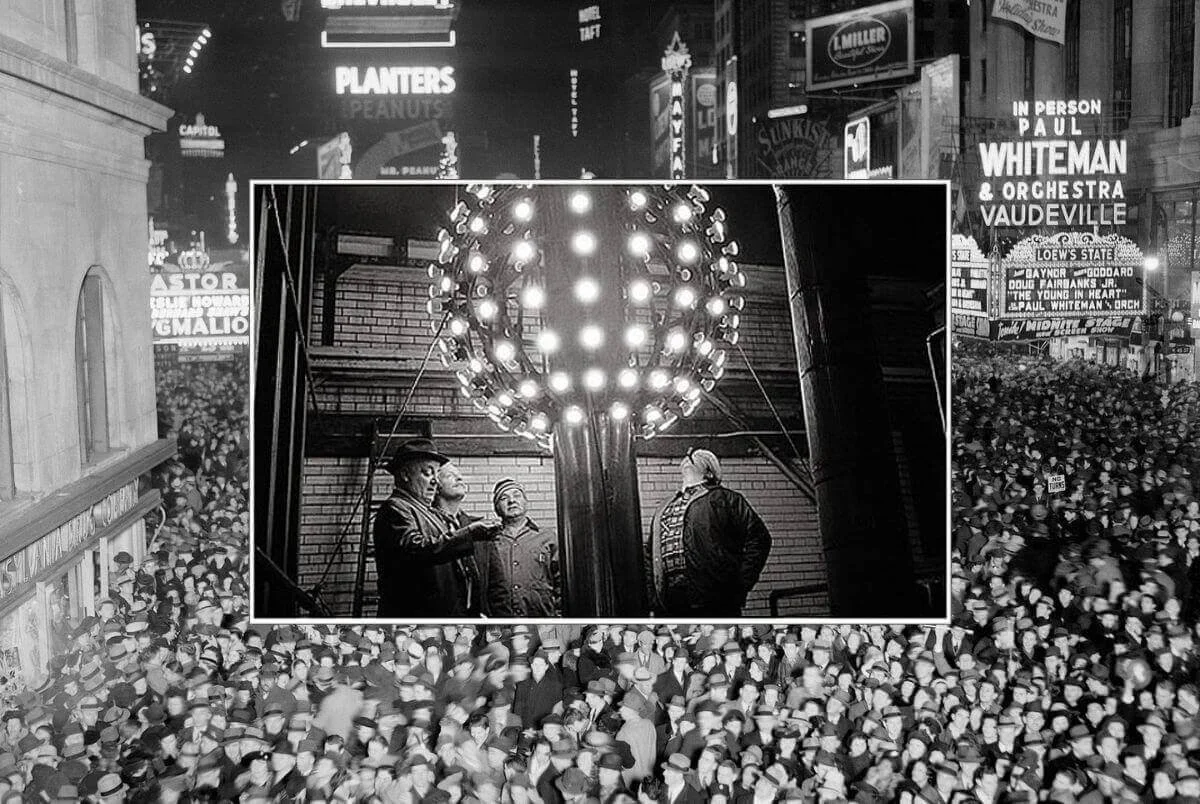
The First Times Square NYE Ball
1920–1954 — Second Ball
“The Broadcast Beacon” (descriptive title; no official name)
Made of wrought iron with incandescent lighting, this Ball carried the ritual through the Jazz Age, the Great Depression, and World War II.
The Ball did not drop in 1942 and 1943 due to wartime blackout regulations intended to prevent illuminating the skyline and aiding enemy navigation.
1955–1980 — Third Ball
“The Atomic Age Sphere” (descriptive title; no official name)
An aluminum construction with incandescent bulbs, reflecting postwar modernization, lighter industrial materials, and streamlined industrial design.
1981–1988 — Fourth Ball
The Big Apple Ball (official name)
An aluminum Ball with incandescent lighting, redesigned as a red apple to align with New York City’s tourism revival and the iconic I ❤️ NY campaign.
1989–1994 — Fifth Ball
“The Continuity Globe” (descriptive title; no official name)
A return to a clean aluminum sphere, emphasizing stability and continuity after the themed apple years.
1995–1998 — Sixth Ball
“The Spectacle Sphere” (descriptive title; no official name)
An aluminum Ball adorned with rhinestones and illuminated by halogen lighting, marking a transition toward greater visual spectacle.
1999–2006 — Seventh Ball
The Millennium Ball (official name)
Introduced Waterford Crystal for the first time, mounted on an aluminum frame and illuminated by halogen lights, symbolizing craftsmanship and permanence at the turn of the millennium.
2007–2024 — Eighth Ball
The Crystal / LED Ball (commonly used name; no distinct formal title)
Fully transitioned to Waterford Crystal panels with LED lighting, enabling digital programming, color-changing effects, and major energy-efficiency gains during the era of smartphones and social media.
This Ball was also used in 2007 as the Centennial Ball to celebrate 100 years of the Ball Drop tradition.
2025–present — Ninth Ball
The Constellation Ball (official name)
A star-inspired Waterford Crystal design featuring solid circular crystal panels and interactive LED light pucks, emphasizing global connectivity, eternal positivity, and interconnectedness, and fully synchronizing sight, sound, and motion.
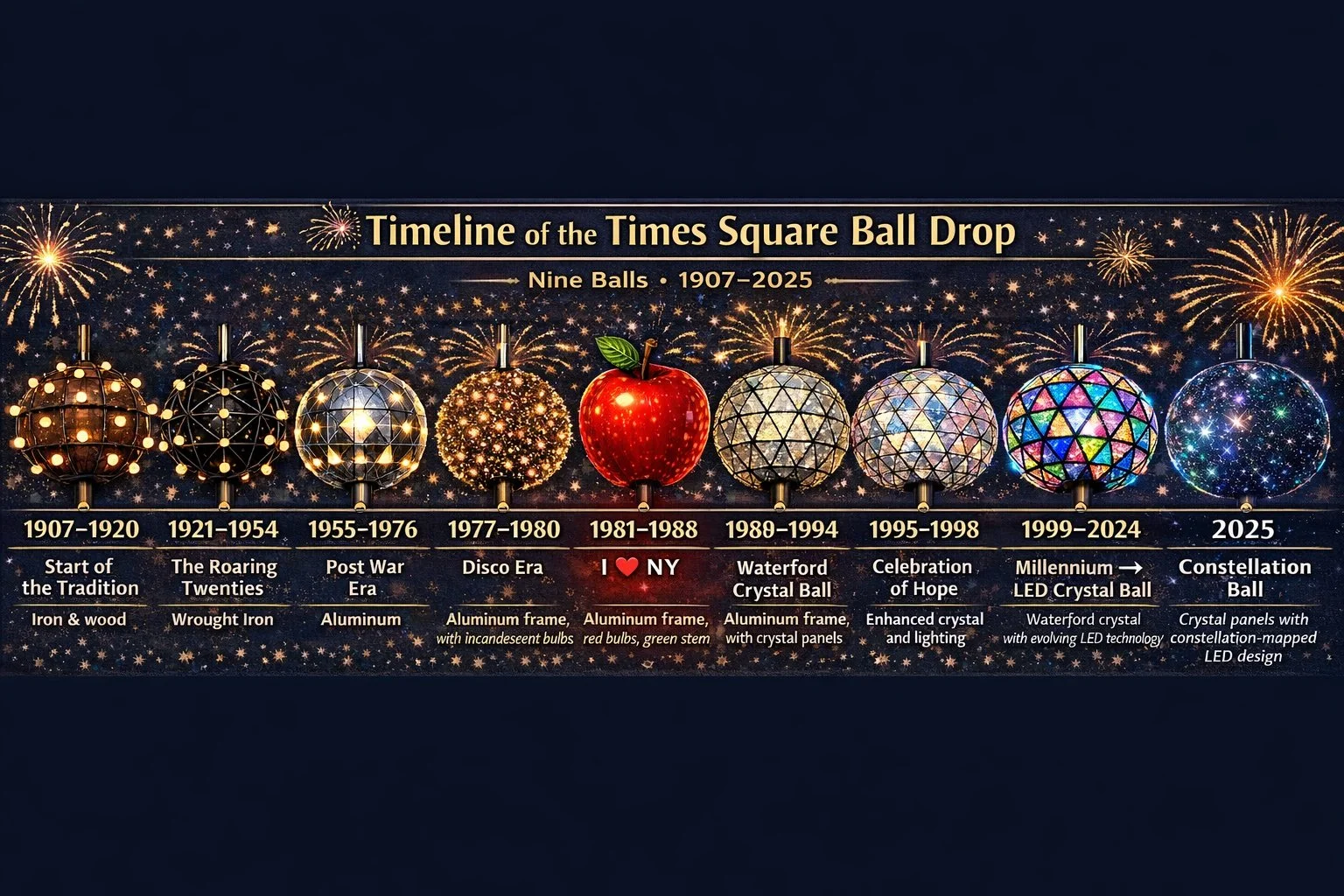
An AI generated timeline of the nine iterations of the Times Square NYE Ball I created. Enjoy!
The Constellation Ball: Sight + Sound + Motion
Timekeeping has come full circle.
We began with sound (bells, cannons, and gunshots).
We moved to sight (Time Balls).
We returned to sound (radio).
And now, with the Constellation Ball, time is expressed through sight, sound, and motion—fully synchronized.
In the Crowd
I was there!
The Ball danced.
The light pulsed.
The audio drove the movement.
Like the moon, which moves oceans simply by being present, this Ball carried charge.
Attention creates intensity. Focus amplifies power.
Observed at scale, the Constellation Ball wasn’t static— it was electric.
Nearly one million people gathered in Times Square. Over one billion watched worldwide. For the first time in my life, I was part of THAT crowd— one that I’d admired for years on TV – interconnected in time and space, revering what had passed, honoring what was present, and looking forward to what’s ahead.
After the twists and turns of 2025, being there mattered.
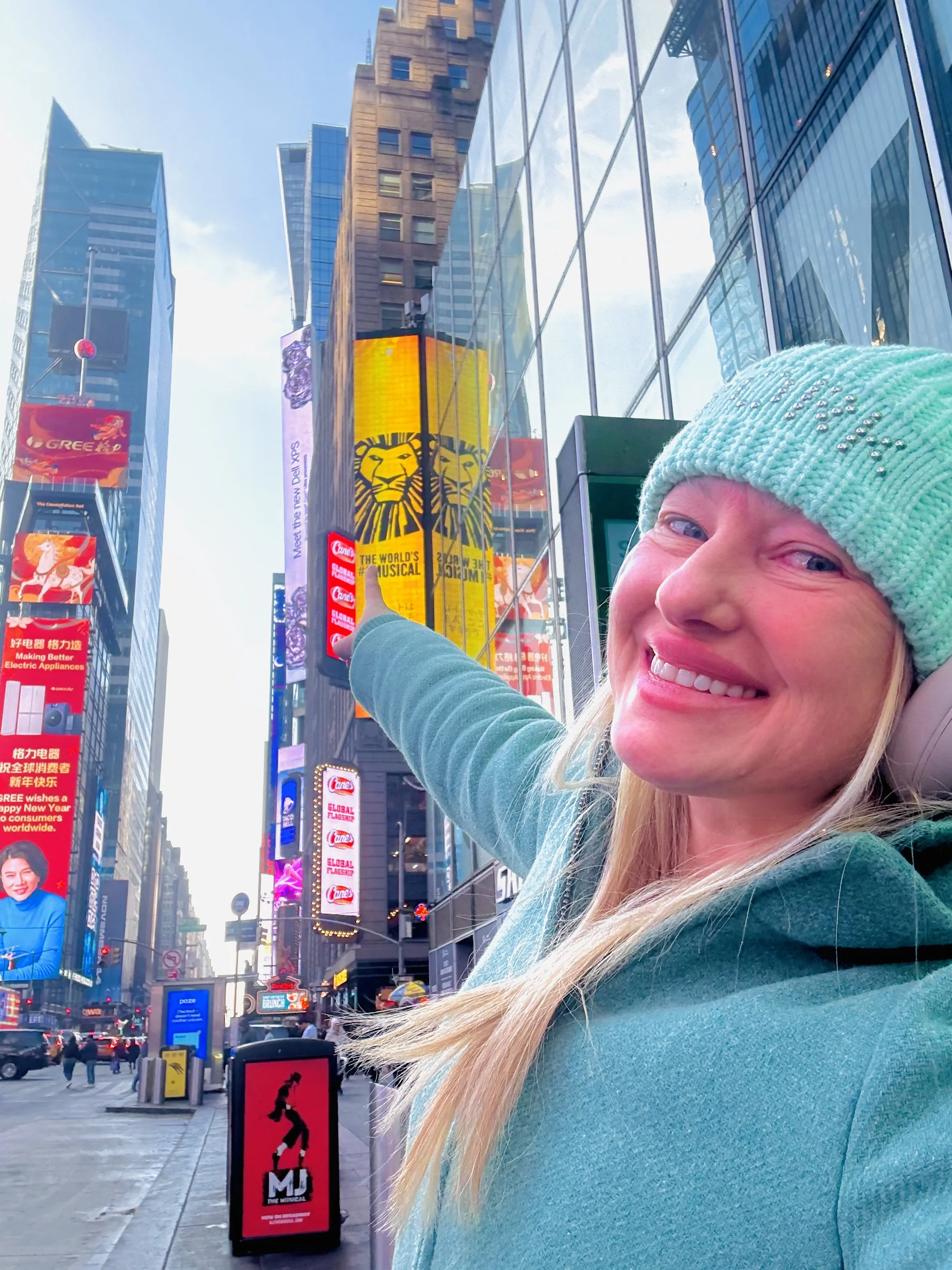
There I am, at The NEW Constellation Ball in New York City!
Set Your Focal Point 🪩 Keep Your Eye on the Ball
At its core, the Ball has always been a focal point.
That’s why it works.
Originally, if sailors didn’t agree on the signal, they drifted. That principle hasn’t changed—only the context has.
This year, I’m inviting couples to stay on course, especially when you find yourself, or each other, getting knocked-off. To keep their eye on the Ball. To orient toward the Constellation Ball’s spirit of Eternal Positivity and to consciously invite Infinite Joy, Infinite Light, and Infinite Beginnings into their relationships.
More joy.
More lightness.
More forgiveness and grace.
Because positive beginnings aren’t a one-time event.
They’re something we return to—again and again—when we stay focused on what matters.
What’s Next at CouplesTherapy.co?
Our hearts are open.
The lights are on.
We’re ready.
Now that the Ball has dropped, we’re Cracked Open—and that is our theme in January at CouplesTherapy.co.
Stay tuned for an exciting upcoming series exploring vulnerability, psychological mirroring, and the defenses we build—and dismantle—in intimate relationships. We’ll also explore what it means to be constellated, how to move the ball forward in your life and in your relationships, and play a little catch-up for December. We’ve got A LOT to do and very little time… the countdown begins!
An Invitation and a Second Chance!
I intend to revisit the Ball Drop on July 4th, as this year will be the FIRST year we have a second chance to to observe it in in Times Square within a single year, in celebration of America’s 250th birthday. Join me—spontaneously!
Also, if you make it to the Sky Deck before April 2026, you can take an elevator ride to see the Ball up close and get a crystal—in the diameter of your choosing—from the Ball to take home. And if you’re looking for a unique way to get engaged, married, or have a recommitment ceremony, what better way than from this big Ball of positive energy in Times Square?!
The Blog Dropped! We’ve reached the bottom, –I told you this was a piece. Congratulations on making it to the end! As I experienced in conducting this research, I hope in diving in, you learned something NEW, and that celebrating New Year’s Eve will be just a bit more meaningful to you this year and the years ahead.
Here’s to NEW beginnings. 🥂
Happy New Year!
With Love,
Jessica Hansen, LMFT
Founder, CouplesTherapy.co
Resources:
Times Square NYE Ball Drop History: https://www.timessquarenyc.org/nye/nye-history-times-square-ball
Royal Observatory Greenwich – Time Ball: https://www.rmg.co.uk/royal-observatory/attractions/greenwich-time-ball
One Times Square – Preview Experiences: https://onetimessquare.com/preview-experiences
Maritime Greenwich World Heritage – Royal Observatory: https://www.greenwichworldheritage.org/maritime-greenwich/ouv/the-royal-observatory